
The concept of Cyber Kill Chain was created by Lockheed Martin, one of the largest aerospace manufacturers in the world.
The goal is to structure the chain of an attack, serving as a widely used framework in Red Team operations to base the attack process on that of an advanced persistent threat (APT) group, along with the MITRE ATT&CK framework.
Its focus is to work with Intelligence-Driven Defense, which essentially aims to disrupt and interrupt offensive attacks by emphasizing intelligent defense that stays one step ahead of cyber threats, concentrating on threat intelligence from the initial cycle of that specific threat. This involves monitoring, detecting, responding to, and mitigating potential threats preferably before they materialize in your environment.
Lockheed Martin outlines the components for success in five stages:
1- Centralize Operations with a Security Operations Center (SOC) and the well-known 5B’s for change management, which is an important factor in minimizing impacts within your organization.
2- Monitor threats, continuously raising indicators of compromise and KPIs from the security tools you have in place.
3- Conduct training and focus on cybersecurity threat analysis services to provide visibility into daily occurrences; after all, it’s always challenging to stay on top of everything.
4- Focus on mitigating issues and protecting your environment by taking protective measures against threats.
5- Finally, conduct consistent and periodic audits and evaluations of your environment, particularly by performing penetration tests on critical solutions.
About the Cyber Kill Chain
Divided into seven topics, it becomes an excellent framework for understanding the modus operandi of cybercriminals.
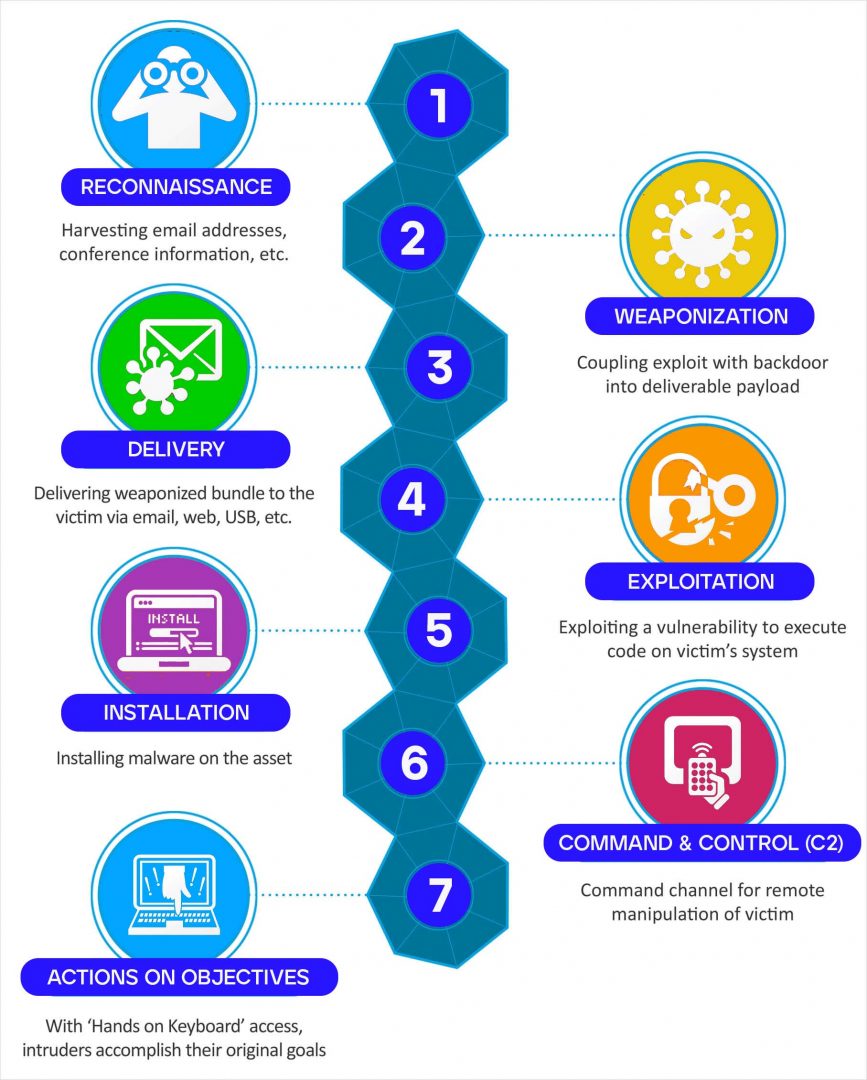
1- Reconnaissance: What method will I use to successfully achieve my objectives? What applications does this company use? What is this company's business model? Who are the key players in the main areas of the company? Conduct OSINT to fully understand the company. In summary, this is the essence of reconnaissance.
2- Armament: Where can I find success? Through phishing? Exploiting vulnerabilities? A malware or backdoor? Social engineering? Based on this, the adversary equips themselves with the best techniques to initiate the compromise.
3- Delivery: Who is my target? How can I gain my initial access? It is through an armament that the attacker will compromise the company without triggering protective mechanisms.
4- Exploitation: After delivery, it is through the vector chosen by the attacker that they will gain initial access. Whether through a vulnerability exploitation or some payload, the first access will succeed while bypassing monitoring mechanisms.
5- Installation: Once inside the target, it is obvious that you need to maintain the connection, and for this, the adversary will use persistence techniques to establish a backdoor through which they can enter and exit undetected.
6- Command and Control: With successful operation, C2 is installed, and from there, the attacker has control over the company’s assets and can exfiltrate data from their target and even create a botnet for other actions.
7- Actions and Objectives: In this final topic, the adversary decides what to do with their target, whether to damage assets, hold them hostage, or simply remain passive while exfiltrating information as evasively as possible.
The Cyber Kill Chain methodology proves highly useful for understanding how an adversary operates and what they seek within a company. Over the last decade, we have seen a significant rise in ransomware attacks compromising various companies, leading to reputational damage and billions in operational losses.
Therefore, in addition to investing in more reactive defense mechanisms, it is highly recommended to test the cybersecurity of systems and the entire infrastructure of your company. Discover our Pentest Solutions for Businesses: https://hackersec.com/empresas/